
A sales funnel is the step-by-step process that guides a potential customer from first discovering your business to making a purchase decision.
You’ll hear it called a purchase funnel or conversion funnel depending on the context and who’s writing the blog post, but the mechanics are identical.
Most businesses either have one or they’re leaving money on the table.
The term “funnel” is a visual metaphor. Wide at the top, where thousands of visitors land, and narrow at the bottom, where a fraction of those visitors become paying customers.
That shape reflects reality: people drop off at every stage of the sales funnel. Not everyone who sees your ad will click it. Not everyone who clicks will buy. The funnel accounts for that natural attrition instead of pretending it doesn’t exist.
The concept traces back to 1898 when E. St. Elmo Lewis introduced the AIDA model (Attention, Interest, Desire, Action). Over a century later, this AIDA sales funnel framework still defines how marketers think about the customer journey.
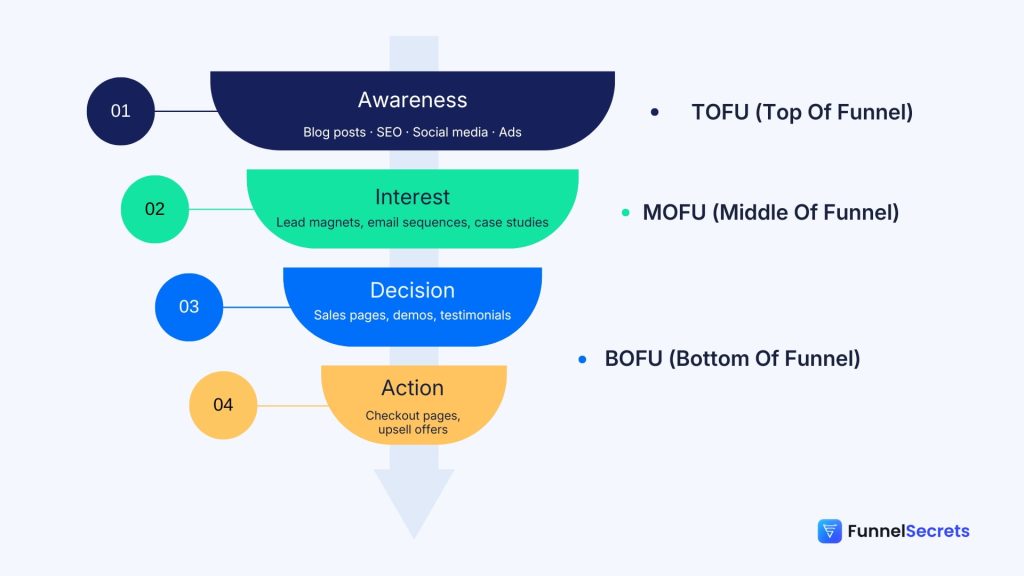
The modern sales funnel model maps to 3 zones:
- Top of Funnel (ToFu): where strangers discover your product or service
- Middle of Funnel (MoFu): where they evaluate your offer
- Bottom of Funnel (BoFu): where they buy or bounce
Every sales funnel follows 4 core sales funnel stages: Awareness, Interest, Decision, and Action. These stages align with different mindsets your prospect moves through during the buying process, from “I didn’t know you existed” to “Here’s my credit card.”
Sales funnels come in several types depending on the business model, such as lead generation funnels, webinar funnels, tripwire funnels, and high-ticket funnels. The right type depends on what you sell and who your target audience is.
Why is a sales funnel important for your business?
Businesses with a well-defined sales funnel convert 2x to 5x more leads than those running random marketing campaigns. That’s especially true for online businesses, course creators, and coaches who can learn funnel strategy through dedicated books, courses, and builder software.
How Does A Sales Funnel Work?
A sales funnel works by pulling in a large pool of potential customers at the top and filtering them through stages of engagement until the most qualified ones become buyers at the bottom.
Not everyone will make it through. People drop off because they’re not ready, not interested, or not the right fit. And that’s a GOOD thing. You only want buyers who genuinely need what you sell.
How does traffic enter the funnel? Through paid ads, blog content, social media posts, and referrals. Social media marketing and content marketing are the two most common ways to fill the top of your funnel.
As prospects move through each stage, they hit touchpoints: visiting a landing page, opening an email, watching a webinar, clicking an ad. Only 1-5% of people who enter the top will reach the bottom. But your funnel data tells you EXACTLY where they leave, so you know what to fix.
How does the AIDA framework map to funnel zones?
- Top of Funnel (ToFu) covers Awareness and Interest. 100% of your traffic enters here, but only 20-30% engages enough to move deeper.
- Middle of Funnel (MoFu) covers Decision and Desire. Prospects evaluate your offer and compare alternatives. Expect 30-50% of engaged leads to move forward.
- Bottom of Funnel (BoFu) is where Action happens. Conversion rates typically land between 1-5% of your original traffic.
This tofu mofu bofu framework lets you pinpoint exactly which zone is leaking revenue. A 1% fix at MoFu might be worth $2,000/month, while chasing more ToFu traffic costs $5,000.
Now let’s put this into REAL numbers.
The average landing page conversion rate across industries is 2.35%, while the top 25% convert at 5.31% or higher (Source: WordStream benchmark data).
Start with 10,000 top-of-funnel visitors. At a 3% opt-in rate, you get 300 qualified leads. If 10% of those leads purchase a $200 product, that’s $6,000 in revenue from a single funnel.
Now you know exactly where the money leaks. And exactly which stage to fix.
What role does email play in moving prospects through the funnel?
Email is the backbone of middle-of-funnel nurturing, with an average ROI of $36 per $1 spent (Source: Litmus).
For businesses using sales funnel builder software like ClickFunnels or GoHighLevel, the entire process runs on autopilot. Opt-in pages capture leads, email sequences nurture them, and checkout flows close the sale. No manual follow-up required.
The 4 Key Stages Of A Sales Funnel
The 4 key stages of a sales funnel are Awareness, Interest, Decision, and Action. Each stage represents a specific mindset and behavior pattern that requires a different marketing approach to move the potential customer forward.
Stage 1. Awareness
The awareness stage is the initial phase at the top of the funnel where potential customers first become aware of your product or service. This is the widest part of the funnel (ToFu), and the goal here isn’t to sell anything.
It’s to increase brand awareness among the right people.
At this stage, a potential customer recognizes they have a problem or need and encounters your brand as a possible solution. They arrive through 5 primary channels: organic search (SEO), social media content, paid advertising, word of mouth, and content marketing such as blog posts or videos.
What’s the prospect thinking at this point?
They’re not evaluating your product or service. They’re identifying a pain point.
A prospective customer might search “how to sell courses online” rather than “best funnel builder.” They don’t know what they need yet. They just know something isn’t working.
Blog posts, social media posts, short videos, infographics, and podcast episodes. The content that converts at this stage answers the question your prospect just typed into Google, not the product you want to sell them.
Key metric: traffic volume and impressions.
Stage 2. Interest
The interest stage is where prospects actively engage with your content and begin evaluating whether your solution fits their specific need.
They’ve moved from passive scrolling to active investigation. They subscribe, follow, download, or engage.
Four behavioral signals tell you someone has entered this interest stage:
- Email signup.
- Content download (a lead magnet like a checklist or template).
- Webinar registration.
- Repeated website visits.
The content that nurtures interest includes email sequences, case studies, comparison guides, and free resources such as templates, checklists, and calculators. Educational content that addresses specific pain points performs best here.
What exactly is a lead magnet?
A lead magnet is a free resource offered in exchange for an email address. It’s the most common mechanism for transitioning prospective customers from awareness to interest. It solves one narrow problem and earns permission to keep the conversation going.
Key metric: email subscriber rate and lead magnet download rate. Benchmark: 1-5% of traffic converts to email subscribers for most online businesses.
How long should the interest stage last before pushing for a sale?
It depends on the sales cycle length and price point. For products under $100, 3-7 days of email nurturing is typical. For high-ticket offers ($1,000+), expect the process to stretch 2-4 weeks or more.
Rush a high-ticket pitch, and you burn the lead. Drag out a low-ticket offer, and they lose interest.
Stage 3. Decision
The decision stage (also called the consideration stage) is where prospects compare options and evaluate whether your specific offer is the right choice for them.
This is the evaluation phase in the middle of funnel (MoFu) where the potential customer has identified their problem, shown interest, and now compares your offer against alternatives. The decision making process at this stage separates potential buyers from casual browsers.
Prospects evaluate 5 criteria at this stage: pricing, features, reviews and testimonials, guarantees, and ease of use.
The content that converts here includes sales pages, product demos, testimonials, case studies with results, comparison tables, and free trials. This is where PROOF matters more than promises.
What are the biggest objections you’ll face?
The 3 most common objections in the decision making process are:
- “Is it worth the price?” Address with ROI data and comparisons.
- “Will it work for me?” Address with case studies from similar customers.
- “Can I trust this company?” Address with testimonials, guarantees, and social proof.
Key metric: sales page conversion rate. Benchmark: 1-3% for cold traffic, 5-15% for warm or nurtured traffic.
That gap between cold and warm? That’s your nurture sequence doing its job. Sales reps who work warm leads close at 5-10x the rate of cold outreach.
Stage 4. Action
The action stage is the bottom of the funnel (BoFu) where the prospect commits to a purchase, becoming a paying customer.
This is the conversion event: the potential buyer clicks “buy,” submits payment, and becomes a customer. Checkout process, payment processing, order confirmation, onboarding sequence.
Does the funnel end at purchase?
No. And this is where most first-time funnel builders get it wrong.
Increasing post-purchase follow-up (thank-you emails, onboarding sequences, and upsells) by 5% increase profits by 25-95% (Harvard Business Review retention data). Ignoring what happens after the sale is like running a marathon and stopping 50 feet from the finish line. Customer retention starts the moment someone buys.
Here’s another number worth remembering: the probability of selling to existing customers is 60-70%, compared to 5-20% for new prospects. An upsell offers a higher-tier product. A cross-sell offers a complementary product. Turning first-time buyers into loyal customers is where the real profit lives.
The key metrics at this stage are customer acquisition cost (CAC) and customer lifetime value (CLV). The formula that determines funnel profitability: CLV should be at least 3x CAC for a sustainable business.
What about customer loyalty after the sale?
Excellent customer service during onboarding turns buyers into satisfied customers who refer others. Customer feedback at this stage provides the data you need to boost retention across the entire funnel. Satisfied customers become your best marketing channel.
Sales Funnel Stages Comparison
The following table compares the 4 sales funnel stages by prospect behavior, content type, and key metric:
| Stage Name | Prospect Mindset | Best Content Type | Key Metric | Typical Drop-off Rate |
|---|---|---|---|---|
| Awareness | “This might solve my problem.” | Blog posts, videos, social content | Traffic volume, impressions | 70-80% |
| Interest | “I’m buying this.” | Lead magnets, email sequences, case studies | Email subscriber rate (1-5%) | 50-70% |
| Decision | “Is this the right solution?” | Sales pages, demos, testimonials | Sales page conversion (1-15%) | 60-85% |
| Action | “I’m buying this” | Checkout pages, upsell offers | CAC and CLV (CLV ≥ 3x CAC) | 20-40% cart abandonment |
Drop-off rates vary by industry, sales cycle, and funnel type.
Optimizing the transition BETWEEN stages (not just individual stages) is what separates high-converting funnels from ones that bleed money. Different types of sales funnels may emphasize certain stages over others depending on your business model.
Main Types Of Sales Funnels
Sales funnels come in multiple types, each designed for a specific business model and conversion goal. A sales funnel depends on your target audience, price point, and how long the buying process takes.
The 3 broadest categories are lead capture funnels, direct sales funnels, and relationship funnels. Within these categories, there are over 10 distinct funnel types that online businesses use today.
- Lead Capture Funnels collect contact information from potential customers. This category includes lead generation funnels, quiz funnels, and free trial funnels. Best for building an email list and warming up prospects before a sales pitch.
- Direct Sales Funnels drive immediate purchases. This category includes tripwire funnels, product launch funnels, and e-commerce funnels. Best for products under $200, where the buying process takes 1-7 days and the buyer doesn’t need weeks of nurturing.
- Relationship Funnels build trust before a high-value sale. This category includes webinar funnels, high-ticket funnels, and membership funnels. Best for coaches, consultants, and course creators where the prospective customer needs to know, like, and trust you before spending $1,000+.
How do you choose the right funnel type?
The right funnel type depends on 3 factors:
- Product price point.
- How much education the buyer need before purchasing.
- The business model (e-commerce vs. service vs. information product).
A $27 ebook doesn’t need a webinar funnel. A $5,000 coaching program doesn’t work with a basic sales funnel checkout page. Match the funnel complexity to the buying process complexity.
A traditional sales funnel for b2b sales looks different from a direct-to-consumer version. B2B funnels typically have longer cycles, involve multiple decision makers, and require the sales team to handle a consultative selling process. Business to business funnels include discovery calls, proposals, and contract negotiations that consumer funnels skip.
Each of these categories contains multiple specific funnel types with different structures, page counts, and email sequences. For the full breakdown of every funnel type with setup guides and templates, see our guide on types of sales funnels.
Why Every Online Business Needs A Sales Funnel
Every online business needs a structured funnel because it turns strangers into customers, replacing random marketing and sales efforts with a predictable, measurable system.
These 5 benefits explain why a funnel is non-negotiable for any online business:
- Revenue predictability: A structured funnel lets you calculate: if X visitors enter the top and Y% convert at each funnel stage, Z revenue is generated. Run the math: 10,000 visitors × 3% opt-in × 10% purchase × $200 product = $6,000 monthly revenue.
- Automation advantage: A funnel automates follow-up that would otherwise require manual effort from your sales team. Businesses using marketing automation see a 451% increase in qualified leads (Annuitas Group study). That means your email sequences, retargeting ads, and checkout reminders run on autopilot while you focus on product development or customer success.
- Scalability: A funnel scales without proportional labor increase. Doubling ad spend doubles top-of-funnel traffic, and the funnel handles the rest. You don’t need to hire 10 more sales reps. The system does the work that a full sales team would handle manually.
- Customer insight: A funnel provides customer data at each stage, revealing exactly where prospects drop off and what needs improvement. This customer behavior data tells you more about your target audience than any survey. Your opt-in rate is 1% instead of 3%? The landing page needs work. Sales page converting at 0.5%? The offer or copy needs a rethink. Data replaces opinions.
- Competitive necessity: 68% of companies have not identified or measured their sales funnel (Salesforce data). Businesses that do have a clear funnel outperform those that don’t.
If your competitor has an effective funnel and you don’t, they’re converting the same traffic more efficiently than you are.
The value of a funnel compounds over time. Each optimization at one stage multiplies across every stage below it. A 1% improvement at the top ripples through every stage beneath it.
How To Build A Sales Funnel: A Step-by-Step Overview
To build a sales funnel, define your target audience, create a lead magnet, build a landing page, set up an email nurture sequence, design a sales page, and add post-purchase follow-up.
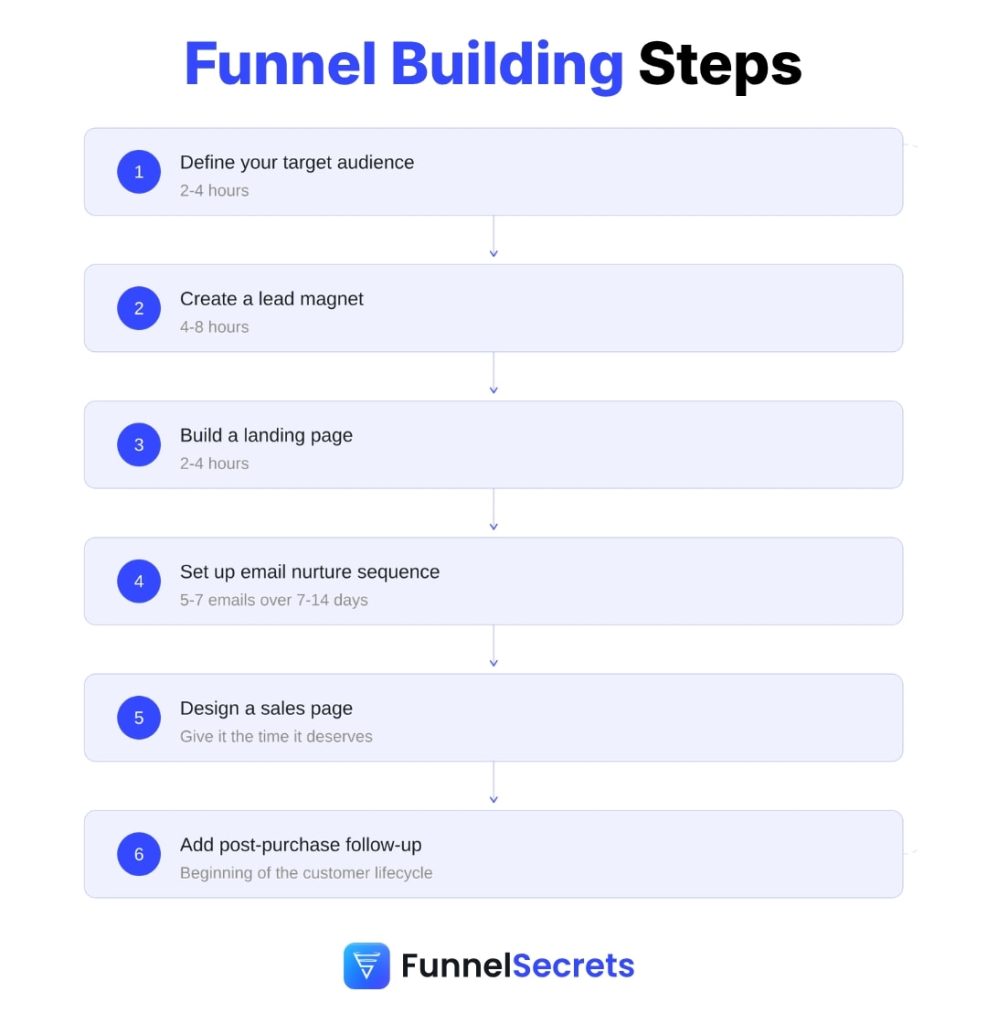
The entire process takes 1-4 weeks, depending on complexity and the sales funnel builder software you choose.
This is a high-level overview of the sales funnel steps. Here’s the framework to get you from zero to a working funnel:
- Step 1. Define Your Target Audience: Identify the specific group of target customers whose pain points your product or service solves. Not “everyone who wants to make money online.” More like “course creators earning $5K-$20K/month who want to automate their sales process.” Build buyer personas based on market research. Time investment: 2-4 hours.
- Step 2. Create a Lead Magnet: Develop a free resource (a checklist, template, or mini-course) that solves one narrow pain point for your target audience. The lead magnet gets potential buyers through the door. Don’t overthink this. Solve one problem well. Time investment: 4-8 hours.
- Step 3. Build a Landing Page: Create a single-purpose landing page with one call to action. No navigation menu. No distractions. Just the offer and an opt-in form. Use a funnel builder such as ClickFunnels, Systeme.io, or GoHighLevel. Time investment: 2-4 hours.
- Step 4. Set Up Email Nurture Sequence: Write 5-7 automated emails over 7-14 days. Introduce yourself, deliver value, share case studies, address pain points, and make the offer. Use ConvertKit, ActiveCampaign, or GoHighLevel for marketing automation. Align your preferred communication channels with where your buyer personas spend time.
- Step 5. Design a Sales Page: Create a page presenting your product or service with benefits, testimonials, pricing, and a guarantee. This page does the selling. Budget 8-16 hours for your first sales page, including headline testing and testimonial collection.
- Step 6. Add Post-Purchase Follow-Up: Automate thank-you emails, onboarding sequences, and upsell offers. This step is where you improve customer retention and turn one-time buyers into loyal customers. The sale isn’t the end of the funnel. It’s the beginning of the customer lifecycle.
How long until you see results?
Most first-timers finish a basic funnel in the next few weeks working part-time. The key is launching an imperfect version, then optimizing based on customer behavior and conversion data.
Each of these steps involves specific sales funnel strategies, tools, and templates. For the complete walkthrough with screenshots and platform-specific instructions, see our detailed guide on how to build a sales funnel.
Sales Funnel Examples: 3 Real-World Walkthroughs
Real-world sales funnel examples show how the 4-stage framework applies to different online business models, from e-commerce stores to course creators to coaching businesses. Each example follows the same funnel stages but adapts the buying process to fit the target audience.
The following 3 sales funnel examples illustrate how different business types structure their customer journey:
Example 1: E-commerce Product Funnel.
A skincare brand runs a Facebook/Instagram ad targeting women aged 25-40 searching for acne solutions (awareness stage). The ad sends traffic to a product landing page with a 15% discount code for first-time buyers (interest stage). Visitors who don’t purchase see retargeting ads from marketing campaigns plus a 3-email sequence featuring customer testimonials and before/after photos (decision). The checkout page includes a “buy 2, get 1 free” upsell (action).
Typical end-to-end conversion: 1-3%.
Example 2: Online Course Funnel (Webinar Type).
A marketing educator publishes SEO blog posts and YouTube videos driving organic traffic (awareness). Visitors opt into a free 60-minute webinar on “How to Get Your First 1,000 Email Subscribers” (interest). After the webinar, a 3-part email sequence delivers a case study showing how a student went from 0 to 5,000 subscribers in 90 days (decision). The final email links to a sales page for a $497 course with a 30-day guarantee and payment plan option (action).
Typical conversion: 2-5% from webinar to sale.
Example 3: B2B Sales Funnel (Consulting/High-ticket Type).
A business consultant posts LinkedIn content, and a guest appears on podcasts (awareness). Interested future prospects land on a free strategy call booking page with qualifying questions (interest). During the discovery call, sales reps present a custom proposal based on the prospect’s pain points (decision). Qualified prospects sign a 6-month consulting contract at $5,000-$10,000 (action).
Typical close rate: 15-30% from qualified calls. B2B selling takes longer than consumer funnels because the decision making process involves multiple stakeholders.
What’s the pattern across all 3 examples?
The structure stays consistent across all business types. What changes is the content at each stage and the length of the nurturing period. An e-commerce impulse buy needs 3 days. A high-ticket b2b engagement needs 3 weeks.
After testing multiple funnel structures for course launches, the webinar-to-email sequence consistently produces the highest conversion rates in my experience at Funnel Secrets.
For more sales funnel ideas and inspiration, explore my complete collection of sales funnel examples.
What Is The Difference Between A Sales Funnel And A Marketing Funnel?
A sales funnel focuses on converting leads into paying customers through direct sales activities. Marketing focuses on attracting strangers and turning them into qualified leads through content and marketing campaigns.
Marketing feeds into the top of the funnel.
Marketing owns top-of-funnel: getting strangers to raise their hands. The difference is that marketing measures reach (impressions, clicks), while the sales funnel measures conversion (opt-ins, purchases).
The funnel picks up at the mid-to-bottom, converting those leads into buyers through email sequences, sales pages, demos, and checkout flows. In larger organizations, this is where the sales team takes ownership.
Where do they overlap?
The interest stage is where both funnels intersect. Marketing captures the lead; the sales process nurtures that lead toward purchase. In the AIDA model, marketing efforts typically handle Awareness and Interest. Sales efforts handle Desire and Action.
What about a sales pipeline?
A sales pipeline tracks individual deals from a sales rep’s perspective: deal stages, follow-up tasks, closing probability. The funnel tracks the customer journey from the buyer’s perspective.
Pipeline is internal tracking. Funnel is the customer experience. Both matter, but they measure different things. Your pipeline tells the team which deals to prioritize. Your funnel tells you which stages of the buying process need optimization.
Understanding the distinction between a sales funnel vs marketing funnel helps larger teams divide responsibilities. The difference between a sales funnel vs sales pipeline clarifies internal versus external perspectives on the same revenue process.
| Criteria | Marketing Funnel | Sales Funnel |
|---|---|---|
| Objective | Generate awareness and capture leads | Convert leads into paying customers |
| Owner | Marketing team / content team | Sales team / automated sequences |
| Key Activities | SEO, ads, social media, content creation | Email sequences, sales pages, demos, checkout |
| Key Metric | Traffic, impressions, lead volume | Conversion rate, CAC, CLV |
| Primary Tool Type | CMS, ad platforms, social tools | Funnel builders, CRM, email automation |
For most online entrepreneurs, these marketing and sales efforts merge into one automated system. A solopreneur using ClickFunnels or GoHighLevel handles both functions within one platform.
Understanding the AIDA framework helps bridge both functions, whether you’re a one-person operation or a sales team of 50.\
Frequently Asked Questions About Sales Funnels
Do I Need A Sales Funnel For A Small Business?
Yes. A funnel benefits any business regardless of size. Small businesses gain the most because funnels automate lead nurturing that would otherwise require a dedicated sales team.
You don’t need a complex 20-page funnel. Start with a simple 3-page setup (landing page, email sequence, sales page) and build from there. No expensive software required.
How Much Does It Cost To Build A Sales Funnel?
Costs range from $0 to $500 per month for tools, depending on the platform.
Three pricing tiers cover most use cases:
- Free tier: Systeme.io’s free plan offers basic funnel building with up to 3 funnels and 2,000 contacts.
- Mid tier ($50-$100/month): Platforms like GetResponse and Leadpages provide more templates and integrations.
- Premium tier ($100-$300/month): ClickFunnels and GoHighLevel deliver advanced features, split testing, and CRM functionality.
What Is the Best Sales Funnel Software?
The best sales funnel software depends on two things: your business model and your budget. There’s no single “best” option because a course creator and an agency owner need VERY different tools.
Here’s the quick breakdown:
- ClickFunnels is best for high-converting sales pages. Its drag-and-drop editor and built-in A/B testing help you squeeze more revenue out of every visitor, without hiring a developer.
- GoHighLevel is best for agencies and all-in-one automation. It replaces your CRM, email tool, appointment scheduler, and funnel builder under one roof, so you stop paying for 5 separate subscriptions.
- Systeme.io is best for budget-conscious beginners. You get funnels, email marketing, and even an affiliate program manager on their free plan, making it the easiest way to launch without risking a dollar.
What about course creators? Kajabi bundles your courses, community, email marketing, and sales funnels into one platform, so you don’t need to duct-tape 4 different tools together.
And if you just need simple lead capture without the complexity? Leadpages lets you spin up high-converting landing pages and opt-in forms in minutes. No funnel-building learning curve required.
Is A Sales Funnel The Same As A Website?
No. A website is a multi-page destination where visitors browse freely. Your About page, blog, pricing, testimonials. They explore, they learn, they leave. No specific path, no single goal.
A sales funnel is the opposite. It’s a focused, sequential path where every page has ONE job: move the visitor to the next step.
A typical online sales funnel flows like this:
- Landing page captures attention and collects the lead
- Video sales letter (VSL) page presents the offer and builds desire
- Order page closes the sale
- Upsell page increases the average order value
- Downsell page rescues the “no” with a lower-priced alternative
- Thank you page confirms the purchase and sets up the next relationship step
Sure, these are technically “web pages.” But they’re NOT a website. Each page has a single goal and one clear next step. No menu bar, no sidebar, no 15 links pulling you in different directions. Forward or out. That’s it.
Most businesses use both. A website builds your brand and brings in organic traffic. A funnel converts that traffic into buyers. We break down the full comparison in my sales funnel vs website guide.
How Is A B2B Sales Funnel Different From B2C?
A b2b funnel typically has a longer sales cycle, involves multiple decision makers, and requires more sales team involvement. In business to business selling, the buying process includes discovery calls, proposals, and contract negotiations.
B2C funnels move faster because one person controls the decision making process. B2B strategies focus on building trust through market research, thought leadership, and personalized demos. Each stakeholder needs to see ROI data specific to their department before they’ll approve a purchase.
Start Building Your Sales Funnel Today
You now know what a sales funnel is: a structured path that moves strangers through awareness, interest, decision, and action until they become paying customers.
That’s the framework. Now let’s put it to work.
The fastest way to start? Pick ONE product or offer. Create a simple lead magnet that solves a specific problem your audience has. Then build a 3-page funnel (landing page, sales page, thank you page) using a tool like ClickFunnels or Systeme.io.
That’s it. You don’t need 47 pages, 12 upsells, or a perfect strategy. You need a funnel that’s LIVE, collecting leads, and making offers. You can optimize later.
Want to go deeper? Here are your next steps:
- Understand the difference between a sales funnel vs buyer’s journey so you can map both for your business
- Grab one of these sales funnel books for proven frameworks you can model
- Or fast-track your learning with a sales funnel course that walks you through the process step by step
The gap between “understanding sales funnels” and “making money with sales funnels” is exactly one decision: starting.
Your first funnel won’t be perfect. But a live funnel that converts at 1% beats a perfect funnel that only exists in your head.
Disclosure: This article contains affiliate links. If you click one and make a purchase, I may earn a commission at no extra cost to you. I only recommend products I’ve personally used or thoroughly researched. My opinions are my own.

Author
Key Nguyen
Key is the brainchild behind Funnelsecrets.us. You’ll often find him analyzing conversion rates, tweaking landing pages, and exploring new marketing automation software. He loves to write about sales funnel building and is always tinkering with the latest conversion optimization techniques!
