
AIDA Sales Funnel: Definition, Stages & How To Apply Framework To Your Funnel
April 2, 2026
The AIDA sales funnel is a 4-stage framework (Attention, Interest, Desire, Action) that maps the psychological journey a prospect moves through before buying.
Each stage matches a specific section of your sales funnel. Each stage needs a different approach to content, copy, and conversion strategy.
E. St. Elmo Lewis developed the AIDA model in 1898 to structure persuasive sales talks and advertisements. Marketers and sales professionals later adopted it as the foundation for a modern marketing funnel strategy.
Over 125 years later, the buyer psychology behind it hasn’t changed one bit.
So why does AIDA matter for sales funnel builders specifically?
It gives you the buyer psychology layer that tells you WHAT prospects need to think and feel at each funnel stage. Not just what pages to build.
Most people build funnels based on structure alone. They slap together a landing page, an email sequence, and a checkout page. Then they wonder why nobody buys.
The AIDA model fills the gap between “I built a funnel” and “my funnel converts.”
This article covers the definition of the AIDA funnel, a breakdown of each stage with benchmarks, how to apply it step-by-step, real examples across 3 business types, AIDA for copywriting, whether the model still works in 2026, and how it compares to other models.
At Funnel Secrets, I use the AIDA framework as the strategic backbone for every funnel, copy, and social media marketing campaign.
What Is the AIDA Sales Funnel?
The AIDA sales funnel is a 4-stage marketing and sales framework that describes the psychological steps a potential customer moves through before buying: Attention, Interest, Desire, and Action.

It combines the AIDA hierarchy of effects with the sales funnel. This combination gives you a full view of both the buyer’s mindset and the conversion path.
What exactly is a sales funnel?
A sales funnel is a structured sequence of pages, emails, and offers that moves someone from first contact to completed purchase. Each stage narrows the audience, like a physical funnel.
Wide at the top. Narrow at the bottom.
Prospects drop off at every level, and that’s normal.
And what is the AIDA model?
The AIDA model is a hierarchy-of-effects model originally created by E. St. Elmo Lewis in 1898 for advertising copywriting. The 4 letters represent the cognitive and emotional stages: Attention (awareness), Interest (engagement), Desire (wanting), Action (buying).

Here’s how combining these two works.
The sales funnel gives you the STRUCTURE: what pages and emails to build. AIDA gives you the PSYCHOLOGY: what the prospect needs to think and feel at each page.
Together, they tell you both WHAT to build and HOW to write for it.
How does AIDA differ from a regular sales funnel?
A regular funnel focuses on conversion points and page flow. AIDA adds the buyer psychology layer.
Without AIDA, you know the prospect landed on your page. But you don’t know what emotional state they need to be in to move forward.
That’s like knowing someone walked into your store but having no idea what they’re shopping for.
Lewis originally wrote about 3 principles (attract attention, maintain interest, create desire) in 1898. Marketers added the 4th element, Action, later.
The framework has survived 125+ years because buyer psychology hasn’t fundamentally changed. People still need to notice you, get curious, want what you sell, and then decide to hand over their money.
The channels change. The psychology doesn’t.
How the AIDA Stages Map to Funnel Positions
Each AIDA stage maps to a specific position in the sales funnel.
Attention sits at the Top of Funnel (TOFU). Interest and Desire occupy the Middle of Funnel (MOFU). Action lives at the Bottom of Funnel (BOFU).
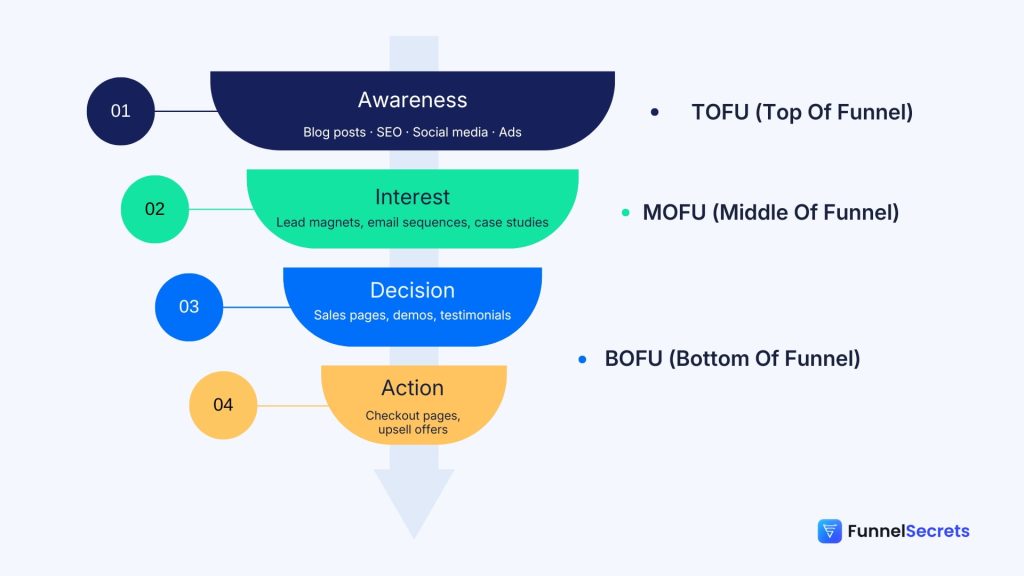
At each stage, a portion of prospects leave. This natural drop-off pattern creates the funnel shape.
Not everyone who becomes aware will become interested. Not everyone who is interested will develop a desire. And not everyone who wants your product will pull the trigger and buy.
Here are the typical drop-off benchmarks across industries:
- Attention to Interest: 70-80% drop-off
- Interest to Desire: 40-60% drop-off
- Desire to Action: 20-40% drop-off
- Overall top-to-bottom conversion: 1-5% for cold traffic funnels, 5-15% for warm/email-driven funnels
| AIDA Stage | Funnel Position | Prospect Mindset | Your Goal | Key Funnel Assets | Primary Metric |
|---|---|---|---|---|---|
| Attention | Top of Funnel (TOFU) | “What’s this?” | Stop the scroll, get noticed | Ad creative, blog posts, social media, YouTube videos, landing page headlines | Click-Through Rate (CTR) |
| Interest | Middle of Funnel (MOFU) | “Tell me more” | Capture contact info, build curiosity | Opt-in page, lead magnet, thank-you page, first nurture emails | Opt-in Rate |
| Desire | Middle of Funnel (MOFU) | “I want this” | Create emotional connection, prove results | Email nurture sequence, webinar, sales page, case studies | Email Click Rate, Time on Page |
| Action | Bottom of Funnel (BOFU) | “I’m ready to buy” | Remove friction, close the sale | Sales page CTA, checkout page, order form, order bump, upsell | Sales Conversion Rate |
Digital funnels don’t always follow these stages in strict order.
Retargeting ads can re-enter someone at the Desire stage. Email sequences can move someone backward from Action to Desire if they abandon checkout.
The table above shows the primary flow. But smart funnels build loops between stages.
The 4 Stages of the AIDA Sales Funnel Explained
The AIDA sales funnel breaks the customer journey into 4 sequential stages. Each stage requires different content, copy tone, and funnel assets to move the prospect forward:
- Attention
- Interest
- Desire
- Action
The following sections explain what happens at each stage, what funnel assets you need, and the specific metrics to track.
1. Attention: Capturing Your Prospect’s Notice
Attention is the first stage where your prospect becomes aware that you or your solution exist. In funnel terms, this is the Top of Funnel (TOFU). Traffic enters through ads, search results, social media, or referrals.

Attention in the AIDA context means pattern interruption.
The prospect is scrolling, browsing, or searching. Your message stops them. This requires a hook that speaks directly to their problem or desire.
Not a generic “Hey, check this out.” A specific “You’re losing $3,000/month because your checkout page has 7 fields instead of 3.”
What makes Attention work?
Not volume. Relevance.
Qualified attention (targeting people who have the problem you solve) fills your funnel with potential buyers. Unqualified attention (clickbait, bait-and-switch hooks) fills it with people who never convert.
You get vanity metrics. Zero revenue.
Here are 3 Attention tactics that work:
- Pain-point headline formula: “Struggling with [specific problem]? Here’s how [specific audience] fixed it in [timeframe].” This works because it combines problem recognition with a believable outcome.
- Pattern-interrupt ad: Open with a surprising statistic or counterintuitive claim. Something like “97% of sales funnels lose money in the first 30 days” stops the scroll because it challenges what the prospect assumes.
- SEO content: Target long-tail queries your ideal prospect is searching. Someone typing “why is my landing page not converting” already knows they have a problem. They just need you to show up with the answer.
Funnel assets at this stage include ad creative, blog posts, social media posts, YouTube videos, and landing page headlines.
The primary metric here is Click-Through Rate (CTR). Benchmark: 1-2% CTR on Facebook/Instagram cold traffic ads is solid. Google Search ads: 3-5% CTR for commercial intent keywords.
The highest-performing Attention hooks I’ve seen at Funnel Secrets target one specific pain point rather than a broad benefit.
“Get more leads” doesn’t stop anyone. “Your opt-in page converts at 8% when it should hit 30%” gets attention.
2. Interest: Building Engagement and Curiosity
Interest is the stage where the prospect moves beyond initial awareness and actively engages with your content. They want to learn more about your solution.

In funnel terms, this is where you capture their contact information through an opt-in or lead magnet.
Interest means the prospect sees potential relevance. They’re no longer passively scrolling. They’re reading, watching, or clicking deeper.
The psychological shift goes from “what is this?” to “tell me more.”
How do you build Interest?
Show you understand the prospect’s specific problem. The fastest way: offer a free resource (lead magnet) that solves a small, immediate piece of their bigger problem.
This creates reciprocity. It positions you as someone who knows what they’re talking about.
Here are 3 lead magnet examples by business type:
- Online course/coaching: Free PDF checklist or 10-minute video training. Something like “The 5-Step Funnel Audit Checklist” works because it gives immediate value with zero fluff.
- SaaS: Free trial or interactive demo. Let people touch the product. A 14-day trial converts better than a 47-minute webinar for most software products because prospects want proof, not promises.
- E-commerce: Discount code or style quiz with personalized recommendations. A “Find Your Perfect [Product]” quiz collects emails AND tells you what to sell them.
What type of lead magnet converts best?
The best-performing lead magnets solve one specific problem quickly. A 1-page checklist or 5-minute video outperforms a 50-page ebook because it delivers value with minimal time investment.
Nobody wants to read your ebook. (Sorry. But it’s true.)
Funnel assets at this stage: opt-in landing page, thank-you page, lead magnet delivery email, and the first 2-3 nurture emails.
Primary metric: Opt-in rate. A well-designed opt-in page converts 20-40% of visitors. Below 20% signals a mismatch between your traffic source and your lead magnet offer.
Either you’re attracting the wrong people or you’re promising the wrong thing.
3. Desire: Turning Interest Into Emotional Want
Desire is the stage where the prospect transitions from “this is interesting” to “I want this.” Desire is emotional, not logical.

In funnel terms, this is the nurture and pre-sell phase. Email sequences, webinars, and sales pages do the heavy lifting here.
What’s the difference between Interest and Desire?
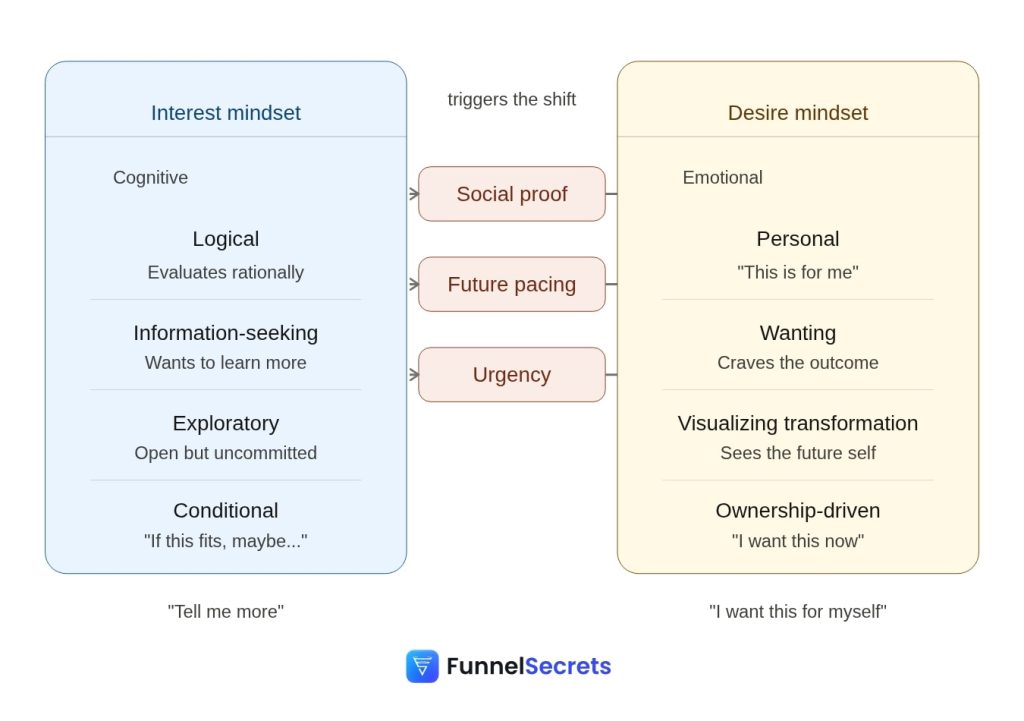
Interest is cognitive: “Tell me more.” Desire is emotional: “I need this for myself.”
The shift happens when the prospect sees a clear gap between where they are now and where they could be with your product. And they believe YOUR product can close that gap.
Three elements drive Desire:
- Social proof: Testimonials, case studies, and before-and-after results with specific numbers. Not “Our customers love us!” but “Sarah went from 0 subscribers to 5,000 in 90 days using this exact funnel.” Numbers make it real. Vague praise doesn’t.
- Future pacing: Help the prospect visualize their life after the purchase. “Imagine opening your laptop tomorrow morning to 12 new sales that came in while you slept.” This works because the brain processes imagined experiences similarly to real ones.
- Scarcity or urgency: Limited-time bonuses, enrollment deadlines, limited spots. This isn’t about fake countdown timers (please don’t do that). It’s about genuine constraints that motivate action over procrastination.
Here are specific tactics for the Desire stage:
- Email sequence: Share a customer success story with specific results. Map emails 3-7 to a specific Desire-building tactic: one email for social proof, one for future pacing, one for objection handling.
- Webinar: Demonstrate your process live and show proof of results. A 60-minute webinar that teaches something real and then presents the offer outperforms a pitch-fest every time.
- Sales page above the fold: Lead with a headline that states the transformation. Follow with a subheadline that includes proof. The first thing they see should answer: “What will my life look like after this?”
Funnel assets: email nurture sequence (emails 3-7), webinar or video sales letter, sales page, and case study page.
Primary metric: Email click-through rate (5-10% is strong) and sales page engagement (time on page, scroll depth).
4. Action: Converting Desire Into a Purchase
Action is the final stage where the prospect makes the purchase decision and completes the transaction.

In funnel terms, this is the Bottom of Funnel (BOFU). It covers the sales page CTA, checkout page, and order form.
Action means the prospect has enough trust, desire, and clarity to commit money.
What’s the biggest barrier at this stage?
Risk. “What if it doesn’t work? What if I waste my money?”
Your job here is to remove every reason NOT to buy.
Three conversion levers drive Action:
- Friction reduction: Fewer form fields, clear pricing, fast-loading checkout, multiple payment options. Every extra step between “I want this” and “I bought this” costs you conversions. Amazon figured this out with 1-Click buying. You should take notes.
- Urgency creation: Countdown timer (a real one), limited bonuses, enrollment deadline. The prospect needs a reason to buy NOW instead of “later.” Because “later” usually means “never.”
- Risk reversal: Money-back guarantee, free trial period, satisfaction guarantee. A 30-day guarantee doesn’t lose you money. It removes the prospect’s last objection. People who would have bought anyway rarely refund. People who wouldn’t have bought now will.
Here are specific tactics for the Action stage:
- CTA button text: “Start My Free Trial” outperforms “Submit” by a wide margin. Use first-person, benefit-oriented CTA text. The button should finish the sentence “I want to…”
- Checkout page: Remove navigation. Show trust badges (SSL, payment logos, guarantee seal). Display a testimonial near the buy button. The checkout page has one job: complete the sale. Anything else is a distraction.
- Order bump: Add a small, relevant upsell on the checkout page to increase average order value. A $27 add-on converts at 30-60% on checkout pages because the buyer has already committed mentally.
What kills conversions at the Action stage?
The 3 biggest conversion killers:
- Unexpected costs appear at checkout.
- A complicated multi-step checkout process.
- No visible trust signals.
Fix these first before testing button colors.
Quick checklist for optimizing the Action stage: clear CTA visible without scrolling, single-page checkout, guarantee displayed above the fold, trust badges near payment fields, testimonial within 200 pixels of the buy button, and at least one urgency element active.
Funnel assets: sales page CTA section, checkout/order form page, order bump, and upsell page.
Primary metric: Sales conversion rate. Benchmark: 2-5% of sales page visitors for cold traffic. 5-10% for warm traffic from email sequences.
Which stage matters most?
It depends on where your funnel is leaking.
If you have traffic but no leads, fix the Interest stage. If you have leads but no sales, fix Desire and Action.
Start by identifying the biggest drop-off point. Then optimize that stage first.
How To Apply the AIDA Framework to Your Sales Funnel
To apply the AIDA framework to your sales funnel, audit each stage against the 4 AIDA principles. Identify the biggest conversion leak. Then optimize the copy and assets at that specific stage first.
Here’s the step-by-step process:
Step 1: Map Your Current Funnel to AIDA Stages. List every page, email, and touchpoint in your funnel. Label each one with its AIDA stage (Attention, Interest, Desire, or Action).
If any stage has zero assets, you found your first gap. Most broken funnels skip the Desire stage entirely. They jump from lead capture straight to the sales pitch.
Step 2: Check Your Traffic Sources (Attention Audit). Are your ads and content reaching people who actually have the problem your product solves?
Check audience targeting, keyword relevance, and ad hook quality. If you’re getting clicks but zero opt-ins, the traffic is wrong. Not the funnel.
Step 3: Evaluate Your Lead Capture (Interest Audit). Is your lead magnet specific enough? Is your opt-in page converting above 20%?
If not, test a more specific lead magnet and simplify the opt-in page. Remove every field except email. Maybe first name.
That’s it.
Step 4: Review Your Nurture Sequence (Desire Audit). Are your emails building emotional connection with proof and stories? Or are they just “checking in” and “following up”?
(Those emails get deleted.)
Map each email to a specific Desire-building tactic: social proof, future pacing, or objection handling. If an email doesn’t do one of these three things, rewrite it or cut it.
Step 5: Optimize Your Checkout (Action Audit). Is your CTA clear? Is checkout friction-free? Is there a visible guarantee?
Test one change at a time. Don’t redesign the whole page at once. You won’t know what worked.
Step 6: Measure and Fix the Biggest Leak First. Track CTR, opt-in rate, email open/click rate, and sales conversion rate.
The stage with the worst performance relative to benchmarks is where you start optimizing. Not the stage you THINK is broken. The one the DATA says is broken.
Here’s an if-then framework to speed up your diagnosis.
If your opt-in rate is below 15%, rewrite your lead magnet headline and test a different offer. If your email click rate is below 2%, add more stories and social proof. If your checkout abandonment is above 70%, simplify the form and add trust signals.
This step-by-step process mirrors the funnel-building methodology I teach in my complete guide on how to build a sales funnel.
AIDA Sales Funnel Examples Across 3 Business Types
The best way to understand AIDA is to see how it plays out in real funnel structures.
The following 3 scenarios walk through all 4 AIDA stages for different business types: an online course creator, a SaaS company, and an e-commerce store.
I built these as illustrative walkthroughs, not case studies. The structure stays the same across all three. The tactics change based on the product, audience, and price point.
Use these as blueprints when you map your own funnel to AIDA.
Example 1: Online Course Creator Funnel
Let’s say you’re a fitness coach selling a 12-week body transformation program priced around $297.
How would AIDA work here?
Attention: You create a YouTube video targeting a pain-point keyword like “why home workouts don’t work.” The video title speaks directly to a frustration your ideal buyer already has. The description link drives viewers to your landing page.
The goal here is simple. Get the right people to click.
Interest: The link goes to a free training opt-in page. Something like: “Watch My Free 20-Minute Training: The 3 Exercises That Replace an Hour at the Gym.”
Keep the page clean. Headline, 3 bullet points, email field, button. Nothing else. Every extra element on this page gives the visitor a reason to leave instead of opting in.
Desire: You send a 5-email nurture sequence after they opt in. One email shares a student success story with specific results. Another email addresses the top objection head-on: “But I don’t have time to work out.”
Each email maps to a Desire-building tactic. Social proof in one. Future pacing in another. Objection handling in a third.
Action: Your sales page opens with a transformation headline and a video showing student before-and-afters. You set an enrollment deadline with a bonus (like a meal plan) that disappears after Friday.
Checkout is one page. Two payment options. No distractions.
Why this works: The YouTube video attracts people with a specific problem. The lead magnet gives them a quick win. The email sequence builds trust through real results. The deadline and bonus push them from “I want this” to “I’m buying this today.”
Example 2: SaaS Company Funnel
Now imagine you run a project management tool for marketing teams, priced around $49/month.
Attention: You run Google Ads targeting a keyword like “best project management software for marketing teams.” Your ad headline matches the search query word-for-word.
Why word-for-word? Because the prospect already typed exactly what they want. Your job is to mirror that language so they feel like they found the right answer.
Interest: The ad leads to a free trial landing page. The page includes a short product demo video (2 minutes max) and a few screenshots of your dashboard in action.
The CTA reads: “Start Your 14-Day Free Trial. No Credit Card Required.”
That “no credit card” line matters. It removes the friction of commitment before the prospect has experienced the product.
Desire: Once they start the trial, a 7-email onboarding sequence highlights one key feature per email with a specific use case. One email might show how a marketing agency cut their reporting time from 6 hours to 45 minutes using that feature.
Each email includes a tip the user can apply inside their trial that day. This keeps them engaged and builds the habit of using your tool.
Action: Around day 10, an upgrade prompt appears inside the app. It says something like: “Your trial ends in 4 days. Lock in annual billing and save $120/year.”
A side-by-side comparison table shows exactly what they lose if they don’t upgrade.
Why this works: The search ad catches high-intent buyers. The free trial removes risk. The onboarding emails build habit and proof. The upgrade prompt creates urgency with a clear incentive.
Example 3: E-Commerce Store Funnel
Let’s say you sell a skincare product (like a vitamin C serum) priced around $34 through your online store.
Attention: You post an Instagram Reel showing a 15-second before/after of a customer’s skin transformation over 30 days. The caption calls out a specific comparison: “This $34 serum did what my $200 dermatologist appointment couldn’t.”
That kind of contrast stops the scroll. It’s specific, relatable, and challenges what the viewer assumes about price and results.
Interest: The link leads to your product page. The page features a customer review section and a comparison chart showing your product vs. 3 competitors on price, ingredient concentration, and quality.
Why a comparison chart? Because skincare buyers research. They compare. Give them the comparison on YOUR page so they don’t leave to find it on someone else’s.
Desire: Visitors who leave without buying get an abandoned cart email. The email includes a small discount code and a gallery of customer-submitted photos showing real results.
Subject line: “Still thinking about it? Here’s 10% off + real results from real customers.”
Photos from real buyers do more for Desire than any product description you could write.
Action: Your checkout page is one page. Free shipping kicks in above a certain cart value (the serum plus any add-on crosses the threshold). Trust badges, a “Dermatologist Tested” seal, and a money-back guarantee sit above the payment fields.
An order bump offers a travel-size companion product at a low price. Most buyers say yes because they’ve already committed to buying.
Why this works: The Reel generates attention through visual proof. The product page builds interest with reviews and comparisons. The abandoned cart email reignites desire with social proof. The checkout removes friction and adds value through the order bump.
How To Write Funnel Copy Using the AIDA Framework
AIDA started as a copywriting framework.
Applying it to your funnel copy means writing different types of sentences for each stage: pattern-interrupt hooks for Attention, problem-agitation copy for Interest, transformation-focused proof for Desire, and direct calls-to-action for Action.
Attention copy needs to stop the scroll. Two headline formulas that work:
“Struggling with [specific problem]? Here’s how [number] [audience] solved it in [timeframe].”
Example: “Struggling with low webinar attendance? Here’s how 1,200 coaches doubled their show-up rate in 2 weeks.”
“[Number] [audience] are making this [mistake]. Are you one of them?”
Example: “83% of course creators are making this pricing mistake. Are you one of them?”
Interest copy uses problem-agitation. You show the prospect you understand their frustration better than they do.
“You’ve tried posting on social media and running Facebook ads, but nothing worked because you’re driving traffic to a page that doesn’t convert. Here’s what’s actually going on…”
Desire copy combines transformation with proof.
“After implementing the AIDA funnel framework, Jake went from $1,200/month in course revenue to $11,400/month in 90 days. Here’s exactly how.”
Notice the specifics: a name, a before number, an after number, a timeframe. Vague copy creates vague desire.
Action copy is direct.
Remove ambiguity. Tell them what to do, what they get, and what happens next.
“Click the button below to start your 14-day free trial. You’ll get instant access to all templates, the funnel builder, and live chat support. No credit card required.”
Should you use AIDA in every piece of funnel copy?
Yes.
Every email, ad, landing page, and sales page follows some version of AIDA, even when compressed. A Facebook ad compresses all 4 stages into 3-5 lines. A long-form sales page expands them across the entire page.
The principle stays the same. The length changes.
Here’s a practical tip. Read your funnel copy from top to bottom and label each section with its AIDA stage. If you skip a stage, you’ve found a leak in your copy.
Most copywriting problems aren’t about word choice. They’re about missing stages.
The copy frameworks in this section are the same ones I use for every funnel I review at Funnel Secrets.
Is the AIDA Sales Funnel Still Effective?
Yes. AIDA remains effective as a foundational framework for sales funnels in 2026.
Its core principle (buyers move through awareness, engagement, desire, and action) hasn’t changed despite new technology, new platforms, and new marketing channels.
But what about the “AIDA is outdated” crowd?
The main criticism of the AIDA model is that it assumes a linear path.
In digital funnels, buyers jump between stages. Someone might see your ad (Attention), leave, see a retargeting ad a week later (re-enter at Desire), and buy.
That’s true. But the framework still works because each stage requires different content, even if the order varies.
Your retargeting ad still needs Desire-stage copy. Your checkout page still needs Action-stage elements. AIDA tells you what to write for each context.
Three modern alternatives extend AIDA:
- AIDCAS adds Conviction (overcoming final objections) and Satisfaction (post-purchase experience). This model helps with high-ticket offers where buyers need extra reassurance before and after the purchase.
- RACE (Reach, Act, Convert, Engage) emphasizes post-purchase engagement. It works well for businesses that depend on repeat purchases.
- Value Ladder (Russell Brunson’s model) structures ascending offers from free to premium. Instead of one funnel, you build a staircase of offers at increasing price points.
When should you use a different model instead of AIDA?
If your business depends on repeat purchases and customer lifetime value, extend AIDA with a retention layer. AIDA covers acquisition. It doesn’t cover retention or upselling.
Use the Value Ladder for multi-offer funnels where you want customers to ascend through multiple products.
BCG’s 2025 analysis suggested “influence maps” over linear funnels. This reflects how modern buyers research across multiple touchpoints before purchasing.
This is evolution, not replacement. The underlying psychology (grab attention, build interest, create desire, drive action) still holds. The touchpoints just multiply.
Related reading: Types Of Funnels.
AIDA vs. Other Sales Funnel Models
AIDA is the simplest and most widely used funnel model. But other frameworks add stages for conviction, satisfaction, and post-purchase engagement that AIDA doesn’t include.
The following table compares 5 popular sales funnel models based on their stages, best use cases, and primary limitations:
| Model Name | Stages | Best For | Primary Limitation | Recommended When |
|---|---|---|---|---|
| AIDA | Attention, Interest, Desire, Action | First funnel, simple product launch | No post-purchase stage | You’re building your first sales funnel |
| AIDCAS | + Conviction, Satisfaction | High-ticket offers, YMYL products | More complex to implement | You sell products above $500 |
| RACE | Reach, Act, Convert, Engage | Digital marketing campaigns | Less sales-focused | You run multi-channel digital campaigns |
| TOFU/MOFU/BOFU | Top, Middle, Bottom of Funnel | Content marketing, inbound | No psychological layer | You focus on content-led funnels |
| Value Ladder | Free, Frontend, Mid, Backend | Multi-offer businesses, coaching | Requires multiple products | You have or plan 3+ offers at different prices |
All 5 models describe the same fundamental process: attract, engage, convert.
The differences come down to scope and which stages they emphasize after the initial sale. For most businesses starting out, AIDA gives the clearest and most actionable framework.
Expand to AIDCAS or the Value Ladder as your funnel matures and your product line grows.
Frequently Asked Questions About the AIDA Sales Funnel
What Does AIDA Stand for in Sales?
AIDA stands for Attention, Interest, Desire, and Action. These 4 stages describe the psychological journey a buyer goes through before completing a purchase.
E. St. Elmo Lewis created the framework in 1898. It remains one of the most widely used sales and marketing models across industries, channels, and product types.
Can AIDA Work for B2B Sales Funnels?
Yes, AIDA works for B2B sales funnels.
The stages are the same, but the timeline is longer. The Desire stage requires more social proof, case studies, and ROI data.
B2B buyers often involve multiple decision-makers. The Interest and Desire stages may need content tailored to different roles. The end-user cares about features. The manager cares about efficiency. The budget holder cares about cost justification.
Which AIDA Stage Do Most Funnels Struggle With?
Most funnels struggle with the Desire stage.
Businesses drive traffic (Attention) and capture leads (Interest) well. But they fail to build enough emotional connection and trust before asking for the sale (Action).
The gap between Interest and Action is where most prospects drop off. Fix this by adding more social proof, customer stories, and transformation-focused content to your email nurture sequence.
What Happens When Your Sales Funnel Skips an AIDA Stage?
Skipping an AIDA stage creates conversion leaks.
The most common mistake: jumping from Interest directly to Action. You ask someone to buy before they feel emotionally ready.
This is like proposing on a first date.
Each skipped stage increases the gap between what the prospect feels and what you’re asking them to do. The opposite of a well-structured AIDA funnel is a leaking funnel that loses prospects at every transition point.
Disclosure: This article contains affiliate links. If you click one and make a purchase, I may earn a commission at no extra cost to you. I only recommend products I’ve personally used or thoroughly researched. My opinions are my own.

Author
Key Nguyen
Key is the brainchild behind Funnelsecrets.us. You’ll often find him analyzing conversion rates, tweaking landing pages, and exploring new marketing automation software. He loves to write about sales funnel building and is always tinkering with the latest conversion optimization techniques!
